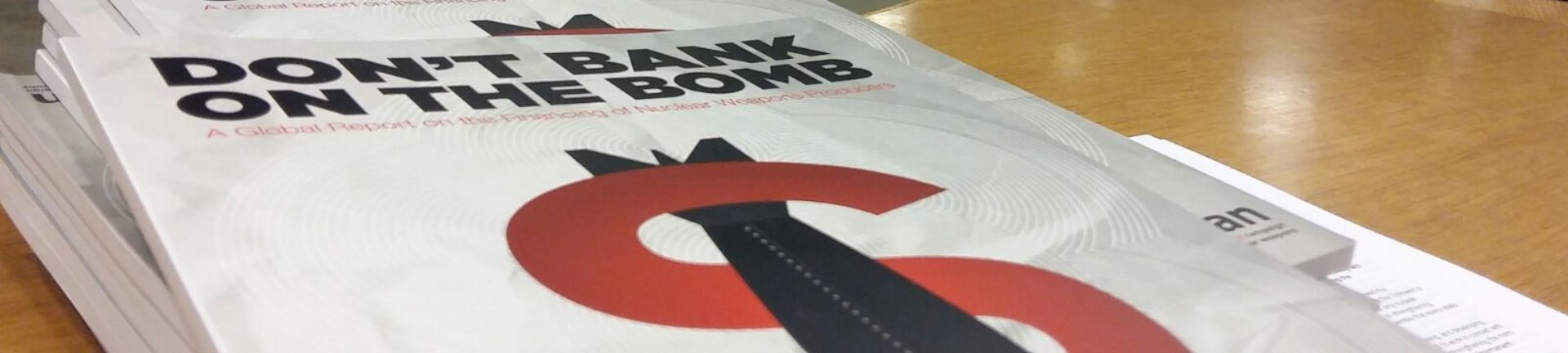
Against the backdrop of increasingly unstable geopolitical circumstances, some European investors are now lifting their nuclear weapons restrictions, allowing for more financial exposure to the defense industry. However, it is exactly in today’s complex security landscape that the financial sector’s role in upholding international norms is more important than ever.
Amid rising levels of military spending and ongoing government pressure to increase investments in the defense sector, a small number of financial institutions has announced adjustments to their weapons policies. In some cases, this has involved changes to existing restrictions or exclusions around nuclear weapons. Among the first was Danske Bank, the largest bank in Denmark, who, while never fully excluding financial ties to the nuclear weapons industry, has now expanded its investment universe to more nuclear weapons producers. Similarly, Swedish bank Skandinaviska Enskilda Banken (SEB) now allows for financial relationships with nuclear weapons companies headquartered in NATO countries. German financial services company Allianz, is already a heavy investor in the nuclear weapons manufacturers, but will now also include them in their ESG funds. Even Danish pension fund PFA, previously listed in the Don’t Bank on the Bomb Hall of Fame for comprehensively excluding any financial ties to the nuclear weapons industry, will now allow investments in companies that contribute to the nuclear arsenals of the US, the UK and France. The pension fund explains that the new policy makes it possible to invest in a broader selection of defense firms “including well-known European companies such as Airbus, Thales, and BAE Systems, as well as the American company Boeing”. Political parties in Norway have similarly urged Norway’s Government Pension Fund to drop its nuclear weapons ban to enable the fund to include more defense stocks in its portfolio, yet this proposal has not gained majority. The fund’s current policy against nuclear weapons has, among others, resulted in the exclusion of Airbus, BAE Systems, Boeing, General Dynamics, L3Harris, Lockheed Martin, Northrop Grumman and Safran.
A frequently cited justification for the (proposed) policy changes is the need to prioritize security amid global tensions and increasing geopolitical uncertainty. These arguments are not unique to the financial sector: Finland, Poland and the Baltic states have all announced plans to withdraw from the 1997 Mine Ban Treaty in the face of increased military threats from Russia. And already before the military escalation of long-standing tensions between Israel and Iran, the Nuclear Non-proliferation Treaty has been under unprecedented pressure as European leaders have been openly discussing expanding Europe’s nuclear capabilities and sharing amid uncertainties over the US nuclear umbrella.
While concerns over Russia’s military threat are understandable, international norms and standards that seek to protect civilians from indiscriminate harm were created to prevent precisely this logic. As the International Committee of the Red Cross has stated “to adopt these rules in times of peace and to abandon them in times of war or increased tensions is to misunderstand their meaning entirely.”
Financial institutions are crucial in reinforcing international norms
Over the past decades, financial sector actors have played a prominent role in strengthening and reinforcing international disarmament norms. Following pressure from the financial sector, companies like Orbital ATK and Textron stopped their involvement in cluster munition. While most European governments have not joined the Treaty on the Prohibition of Nuclear Weapons (TPNW), many European financial institutions nevertheless consider the unimaginable harm that these weapons would inflict on civilians to be a key reason to stay away from the companies that build them. At the core, the argument for their exclusion remains that any use of nuclear weapons would be a gross violation of international humanitarian law, due to their inherent inability to distinguish between military targets and civilians. Respecting human rights means avoiding this risk completely by excluding investments in companies producing these weapons.
If anything, heightened political tensions have only increased the probability of their use, which would have devastating consequences. In its latest annual report, the Stockholm International Peace Research Institute (SIPRI) warns that a new and dangerous nuclear arms race is emerging amid a weakening of arms control regimes.
Nuclear weapons companies’ involvement in irresponsible arms transfers
Moreover, loosening nuclear weapons restrictions is likely to expose investors to a broader spectrum of human rights and liability risks. Airbus, BAE Systems, Boeing, General Dynamics, Lockheed Martin and Thales have all delivered weapons to Saudi Arabia and/or the United Arab Emirates, whose indiscriminate airstrikes in Yemen have left a devastating trail of civilian deaths. In June 2024, UN experts warned that companies supplying arms to Israel, including BAE Systems, Boeing, General Dynamics, Lockheed Martin, Northrop Grumman, Rolls Royce and RTX, risk complicity in serious violations of human rights and international humanitarian law. With respect to financial institutions, the experts noted that “[f]ailure to prevent or mitigate their business relationships with these arms manufacturers transferring arms to Israel could move from being directly linked to human rights abuses to contributing to them, with repercussions for complicity in potential atrocity crimes’’.
As long as arms manufacturers continue to produce weapons that are inherently indiscriminate and inhumane, and supply weapons to governments that pay little attention to human rights, investors should stay away from them. Financial institutions’ past actions have demonstrated their ability and responsibility to drive corporate respect for human rights, even when their own governments lacked the political will to do so. In a time when risks of nuclear war are at a highest, a strong stance by the financial community is more needed than ever.
Image credits: ICAN | Kaspar Fosser